Remembering Cleve Moler
By Matthew Fricke
The Center for Advanced Research Computing (CARC) joins the University of New Mexico and the worldwide research computing community in mourning the loss of Dr. Cleve Moler, former Chair of Computer Science and a giant of high-performance computing (HPC), who died on May 20, 2026, at the age of 86 from Parkinson’s disease. 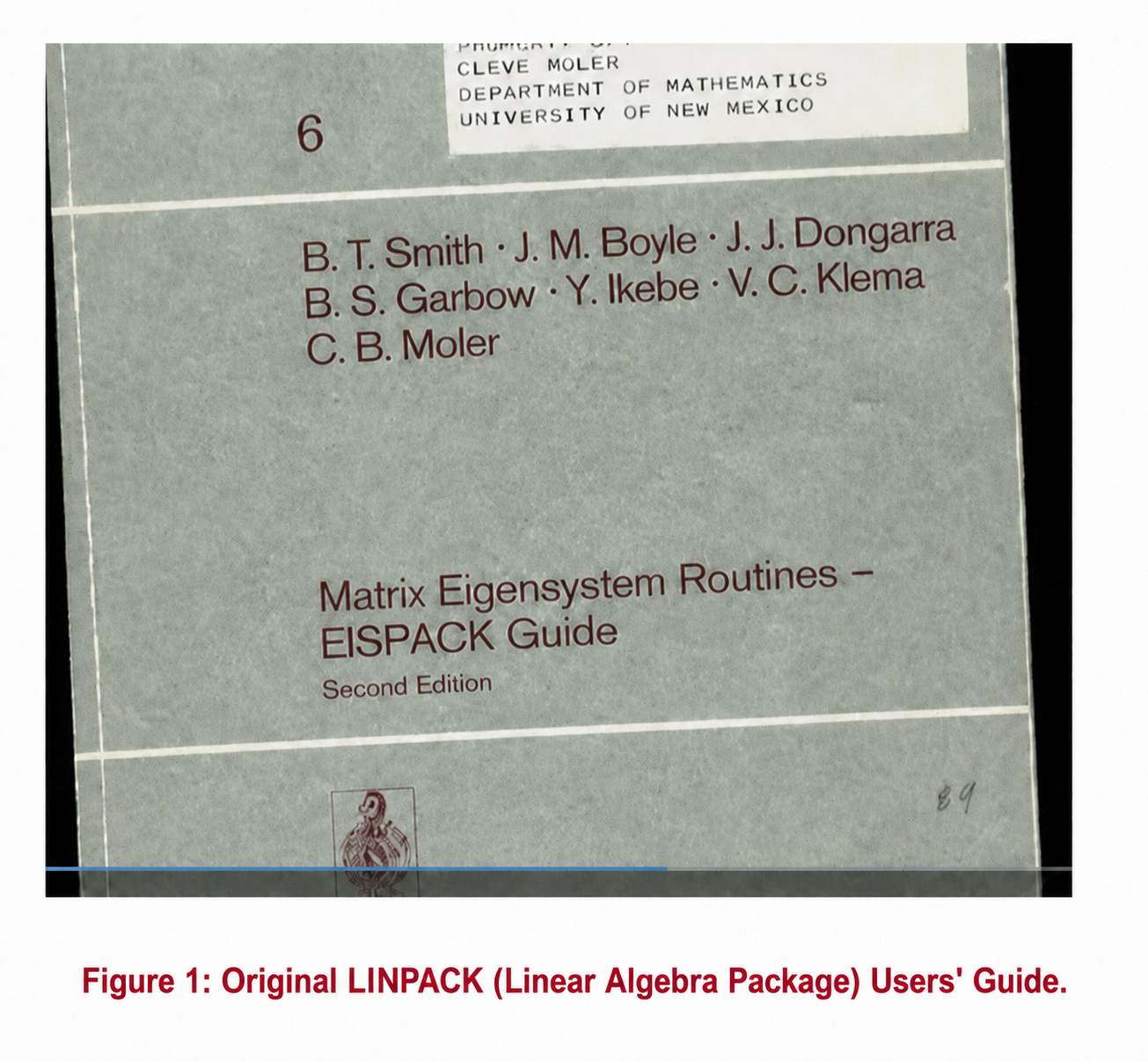
It is difficult to write an article in memoriam without feeling that it is insufficient under any circumstances. But that is especially true when writing about someone who was a towering figure in his field, a beloved elder statesman of the community, and who was a joy to be around. Few individuals have had a greater impact on modern scientific and high-performance computing, and few are remembered with such affection by their colleagues. Moler’s work enabled a revolution in computational solutions to linear algebra problems and made it possible to scale those calculations to the world’s largest supercomputers. Just as importantly, he helped build a community of researchers and practitioners who continue to build on his work and remember him fondly.
Linear algebra is a cornerstone of scientific computing, so enabling efficient and scalable numerical solutions had an enormous impact on modern computing and especially HPC. From climate modeling and aerospace engineering to genomics and artificial intelligence, researchers continue to rely on software, algorithms, and mathematical techniques developed by Moler and his students while at UNM. It is hard to think of a field of supercomputing that didn’t benefit from his work.
So foundational were these algorithms that for decades the largest supercomputers in the world were ranked by how fast they could run them. The result was the TOP500, a list so influential that it became a significant element in multi-billion-dollar purchasing decisions. To this day supercomputing vendors promoting their systems lead with how fast their machines can run the linear algebra benchmarks Moler and his students developed. 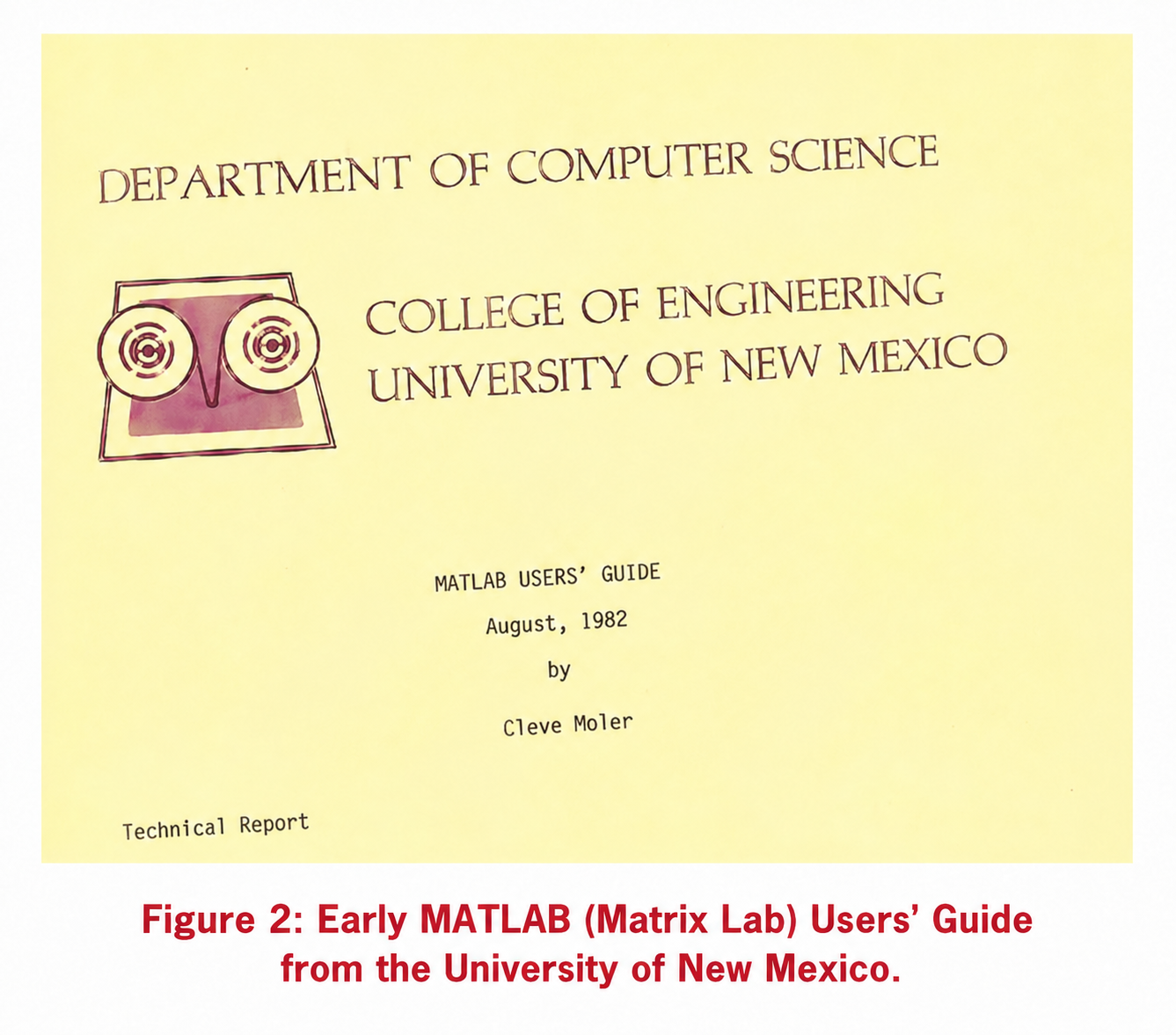
At the other end of the scale, UNM undergraduates preparing to compete in this year’s international Student Cluster Competition in Chicago encounter Moler’s libraries in their very first HPC assignments. Every lecture I give in my HPC courses at UNM has at least a few slides on Cleve and his work. It is often at that moment that students begin to understand the pivotal role New Mexico has played in the history of scientific and high-performance computing. They are often surprised to learn that software foundations they still use today were developed right here in Albuquerque. More than one New Mexico student has remarked that the connection helped inspire them to pursue a career in supercomputing.
Though usually hidden behind the scenes, Moler’s code and algorithms remain a familiar part of everyday life at CARC and every other supercomputing center. When we compile scientific software for researchers, the libraries Moler helped create often form part of the foundation, providing the linear algebra routines required by applications across science and engineering. To computational scientists, these libraries are much like the periodic table is to chemistry: they provide a common foundation upon which a remarkable range of applications are built.
While Moler was helping establish the foundations of scientific and parallel computing, he was working on a related project at UNM. He wanted to give students a user-friendly way to run the linear algebra libraries he was writing. The result was the Matrix Laboratory, better known as MATLAB. By his own account, the hard-core computer scientists in his numerical analysis classes were not impressed, but the engineering students who had to use linear algebra for control theory, structural analysis, circuit design, signal processing, aerospace engineering, and fluid dynamics on a daily basis loved it. What began as a teaching tool in Moler’s classes grew into software used by millions of engineers and scientists around the world. Today, MATLAB has more than four million users and is one of the most widely used software packages on CARC systems.
Moler’s influence extended beyond the algorithms and software systems he developed. He built a community of collaborators and former students. Among his students at UNM was Jack Dongarra, who received the ACM A.M. Turing Award in 2021, often called the Nobel Prize of Computer Science, for his work on high-performance linear algebra libraries.
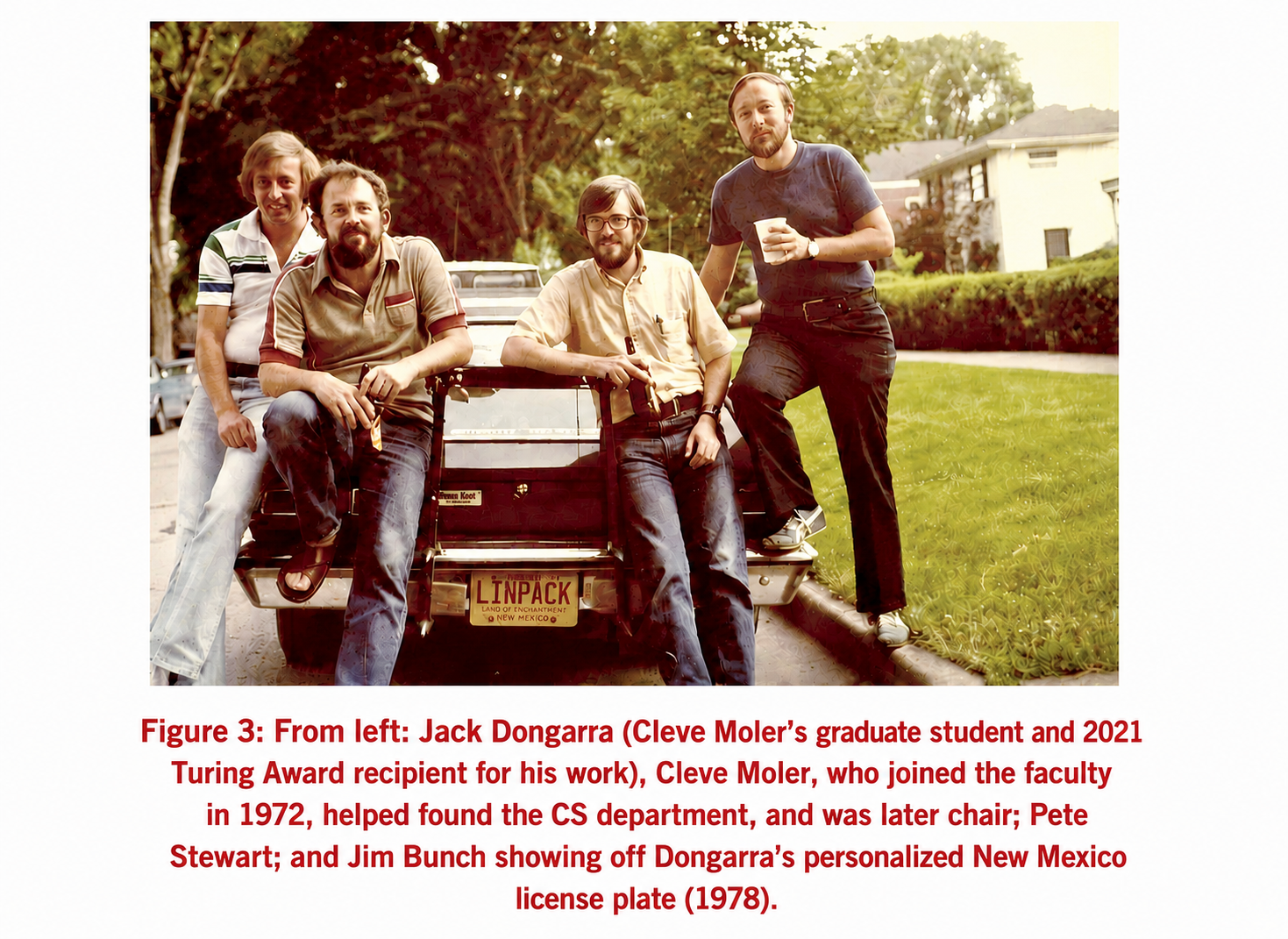
Professor Emeritus Ed Angel, who succeeded Moler as chair of the department, remembered him as both a friend and an extraordinary leader. Reflecting on the formative years of the department, Angel wrote that as chair Moler’s “warmth and outgoing nature led to a department that was collegial, academic-politics free, encouraged interactions with others, was run by consensus and valued both teaching and research.”
“Cleve leaves an amazing legacy. MATLAB started as something he did for his students, became a product that is used by millions and spawned a company that employs thousands. But to me his legacy is his friendship and a CS department that values both quality and collegiality.” In recognition of Moler’s legacy, UNM established the Cleve Moler and MathWorks Endowed Chair in Mathematical and Engineering Software in 2024.
That collegiality was evident at every conference he attended, despite his outsized influence on modern computing, Cleve was always happy to talk with anyone he encountered, whether it was a student wandering the vast conference trade floor with no idea who they were speaking to or a star-struck junior faculty member. In his later years, when he attended conferences in a wheelchair, he was still quick to pull someone aside and, with a barely suppressed mischievous grin, ask:
"How do you convert from C to MATLAB? Add a f**king one!"*
What I loved about that terrible joke was how much Cleve delighted in telling it and how uproariously he laughed at his own punchline. He enjoyed what he did from start to finish. From Caltech student to the big cheese of numerical computing, he was clearly having a blast the whole way, and his enthusiasm was infectious.
When he was unable to attend last year’s Supercomputing Conference because of ill health, his absence was immediately felt. He had been a reassuring and joyful presence there for so many years that the conference no longer felt quite the same without him. I will think of him whenever I use the numerical software he and his collaborators wrote, still quietly doing its work beneath so much of modern scientific computing.
We extend our deepest condolences to Cleve’s family, friends, colleagues, former students, and the many researchers whose work was enabled by his contributions. He will be missed.
*MATLAB like FORTRAN is 1-indexed while C is 0-indexed.